


Mark V Designs
Mark V Commuter 36
Mark V 28
Mark V 20

Mark V 39
Mark V Designs specialized in classic fuel-efficient power boat disigns for the home builder.
See WoodenBoat #167, page 86, for an article about the Mark V 39.
I started building the Mark V 39 in the beginning of August, 2000, and it was launched early September, 2001.
My Dad started building the Mark V 20 in October, 2000, and it was launched in November, 2001.
The Mark V 28 is a smaller, trailerable version of the Mark V 39.
The Mark V 36 Commuter is a design I submited to the WoodenBoat/Profesional Boatbuilder Design Challenge II compitition.
Mark V 20

My Dad wanted a trailerable boat for short cruises, and for traveling across the country exploring different waterways. He didn't want it to be any longer than 20 feet, because that would be the largest size he could fit on the trailer he has. (We baught a used trailer to launch "Heart of Gold" with.)
He wanted a comfortable berth, sitting headroom in the cabin, and an enclosed stand-up pilot house. We started with a design close to Sam Devlin's Surf Scotor, but when it was shortened to 20 feet, the pilot house and cockpit were both too small.
We decided on the pilot house/cockpit combination, with an extended hard top. The sides will be enclosed with canvas.
Speed was not a priority, so it has a semi-displacement hull. A 50 HP 4-stroke is the biggest motor contimplated, which should give a comfortable cruising speed of about 11-12 knots. We used a 25 hp Mercury Four stroke Bigfoot, which pushes the boat 7 knots at 4,000 rpm.
Originally, the motor was going to go in a well, but we decided to mount it on the transom to make more room in the cockpit. There is a full hight watertight bulkhead 2 feet forward of the transom.
The cockpit sole is at the waterline, to give 6'6" headroom under the hard top, so it is not self bailing. There is a sump and a bilge pump for rainwater that may get in.
There are storage compartments on each side of the motor. One of the compartments will house the porti-potti, Which can be moved to wherever is convenient for use. A cooler can be stored on the other side.
The flush deck is stronger and gives more room below than a trunk cabin would have. The forward most part of the deck will be at the level of the lower shear, for anchors and stuff. Anchors will be handled while standing in the forehatch, to save going out on deck. The cabin has a 7 foot long V-berth. There are removable panels so the aft part of the berth can be used as settees, with a nice view through the ports.
Aft of the berth are 2 counters on each side, with shelves above. 18 gallon fuel tanks are under each counter.
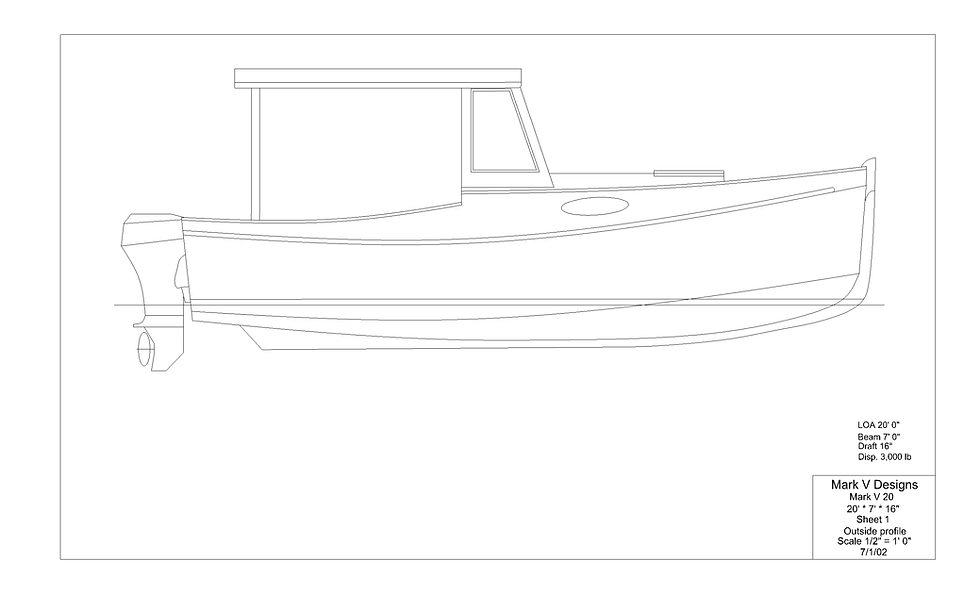

LOA 20 feet
Beam 7 feet
Draft 18"
Disp. aprox. 3,000 lb


+
My Mom and Dad cruised on the original Mark V 20, Pilgrim 4, for a few years, on the Upper Mississippi and Florida.
It now sits in my garage waiting to be restored.

Digital plans for the Mark V 20. $105
+

Mark V 20 and Mark v 39 anchored together
+
+
Mark V 28


Since I have had many requests for a smaller, trailerable version of the Mark V 39, I designed the Mark V 28.
I decided on a V bottomed boat because I didn't like the pounding of the flat bottomed boat. The hull is basically an enlarged version of the Mark V 20, which is very pleasant going into a chop. It doesn't pound at all, and throws very little spray.
The Mark V 28 is relatively easy to build outboard powered houseboat. It will cruise at 6 knots with a 10 hp outboard, or up to 15 knots with a 50 hp outboard.
The interior has 6’ 5" headroom, but if more is needed, the cabin height can built a few inches higher. The cabin interior is 13 feet long. There is a couch forward that folds out to form a double berth. I've lived with that arrangement for over 5 years now, making up the bed every night isn't that much of a hassle. The helm seat is an office chair mounted on a raised platform, when the chair turns around, it is comfortably close to the table.
There is an enclosed head and shower area and a good sized galley.
A hanging locker is under bookshelves aft of the couch.
There are plenty of opening windows for ventilation, and the forward side windows hinge back against the cabin side, for access to the side cleats. You can go through locks without leaving the cabin.
Aft is a self-bailing cockpit with a pair of 27 gallon gas tanks, and lockers for propane tanks, life jackets, and other things. There is also a self-bailing cockpit forward with a large storage area, and a 35 gallon water tank underneath.
There is plenty of room on the roof for a dinghy and solar panels, or a couple of Kayaks.
Construction is mainly plywood and epoxy. The bottom is two layers of 1/2" plywood, and the sides are 1/2" plywood.
The boat is relatively easy to build for an amateur, but you should have some boat building experience before taking on a project this large. Lofting is not necessary, as all the dimensions for the molds and bulkheads are on the plans.
LOA 28' 0 "
Beam 7' 6"
Draft 14"
Disp 4,000 lb


Digital plans for the Mark V 28 $145
Mark V 36 Commuter


Digital plans for the Mark V 36 Commuter. $145
The Mark V 36 Commuter is my submission for the WoodenBoat/Professional BoatBuilder Design Challenge II. The design parameters are:
Must be trailerable, max beam 8’, max length 40’ trailer weight less than 3,500 lb.
Must burn less than 2 gallons an hour at 10 knots in a 2’ chop and 15 knot breeze while carrying 800 lbs (family of 4)
Must include at least spartain accommodations (berths, head, galley) for two adults and two children.
Since the boat is supposed to be fuel efficient, I figured that the potential owner would also be concerned about the initial cost. I designed the boat to be as inexpensive to own and operate as possible.
Plywood on frame construction was chosen to be the quickest and cheapest for amateur construction. It was chosen over stich-and-glue because I think in larger sizes it is no more labor, and easier for a solo builder, since the largest piece that the builder has to deal with is a single sheet of plywood. The boat does not have to be lofted; the actual dimensions of all the bulkheads are on the plans. Dimensional lumber will be standard sizes of pine, which can be picked up at any lumber yard. The bottom is cold-molded with two layers of plywood, since there is quite a bit of twist forward. Epoxy is used for gluing, and the exterior will be sheathed with Xynole-Polyester cloth. The windshield frame, roof supports, rub rails, and trim are varnished hardwood. I stated Mahogany on the plans, but other hardwoods would be suitable.
Outboard power was chosen, because it is much simpler and cheaper than an inboard diesel. Since two gallons an hour would be 20 hp with a gas engine, I used that as a starting point. 20 hp would push this boat at about 10.8 knots in a calm, so it should be able to meet the design parameters. A 25 hp high-thrust four stroke would be adequate, but I chose a 50hp outboard, which should give a top speed of about 14 to 15 knots. At 10 knots, it would be running at less than half throttle, so it will be a lot quieter and smoother than the 25. Two 24 gallon fuel tanks give a range of over 200 miles at 10 knots. The outboard could probably be enclosed in a box, but I decided to leave it in the open. The box would have to be as high as the aft cabin, and extend to the transom. There would also have to be a large ugly cutout in the transom so the motor could tilt up. The motor is not very conspicuous as it is, and 50 hp four-strokes are very quiet, especially if run at lower speeds
Styling was from the 1920’s, because I think that was when power boats were the most elegant. The somewhat boxy styling is also simpler to build. The hull is straight-sectioned V-bottom, which is a good shape for moderate speeds. It will slice through the water cleanly, and will look very elegant at cruising speed. I once was passed by a 70 or so foot 1920’s commuter on the ICW. It was cruising at over 20 knots, and I was impressed by how cleanly the boat sliced through the water. I was hoping to get that effect with a smaller and much less expensive boat.
The cockpit will be able to be completely enclosed in canvas, and it was assumed that most of the time, that is where the crew will be. There is 6’ 6” headroom in the cockpit. The roof is only ¼” plywood, so it is not intended to be walked on, however, a couple of kayaks could be carried up there. The cockpit is not self-bailing, but the canvas should keep rain out. The forward cabin has four feet of headroom, and would mainly be used for sleeping. The headroom is a bit tight, but I didn’t want to raise the freeboard any more, as it would increase the weight and windage. The head was put in an aft cabin, keeping the portable toilet separate from the sleeping area. It also moves the cockpit forward, putting the crew weight closer to the center of buoyancy. The aft cabin will also block the sound of the outboard.
In order to get the boat light enough, there is almost nothing built into the interior. The galley will consist of a portable camp stove and cooler. Water will be in jerry cans, stored under the V-berth. Seating will be folding canvas chairs. The electrical system will be very simple, one starting battery, and one house battery, lights, and a few electronics.
There is a self-bailing anchor locker forward. Anchor handling will be done while standing in the forehatch, so no lifelines will be needed. The working anchor will be 22 pounds, so no anchor cathead is shown.
LOA 36' 0"
LWL 35' 8"
Beam 8' 0"
Draft 1' 0"
Loaded displacement 4,200 lb
Trailer weight 3,200 lb


Mark V 39


I started out with a simple flat-bottomed sharpie hull. The advantages of a sharpie are mainly shallow draft and simple construction. There are numerous disadvantages, though. Sharpies pound in a head sea, and they have steering problems in some conditions. A long deep skeg will help solve some of the steering problems, but I wanted to retain the extreme shallow draft, so I used twin shallow skegs.
The most practical shape for this type of boat would be wall-sided (like Bolger's Sneakeasy design), but I decided that I would sacrafice some ease of construction for style.
The bottom is 8' wide from about midships to the stern.
The sides flare out from the bow toward midships, and then tumble home toward the stern, making a nice sweeping shearline.
The cabin is a "street car" type, like the launches and water taxies of around 1900. There will be room on top for a nice 12' dinghy and plenty of solar panels. The mast will be easy to lower for bridges.
The interior has at least 6'8" headroom throughout.
Aft, there is a stateroom with a couch that converts to a 7' long double bed. Across from that is a large hanging locker and a desk. There is a large bookshelf forward of the bed, and also forward of the desk.
Midships is a 4' by 4' head, with a composting toilet.
Forward, there is an 8' galley, with a 18" wide pantry with sliding shelves. The forward cabin also has a drop-leaf table and a helm. There is enough floor space for a double air mattress for guests.
There are numerous opening windows, and a door leading to the sunken fordeck.
Forward is a large hold for a full-size bicycle, and self-bailing chain locker under the foredeck.
Aft is a cockpit and moterwell for the outboard, and two 25 gallon gas tanks. Storage for propane tanks is beside the motor well.
Construction is mainly plywood and epoxy.
The bottom is one layer of fir toungue-and-groove flooring (from an old house) followed by two layers of plywood to finish 2" thick. The fir flooring is varnished and serves as the cabin sole.
The sides are two layers of 1/2" plywood.
There are watertight bulkheads forward and aft of the cabin, and there are no underwater thru-hull fittings.
It cruises at 8 knots with the Murcery 25 four stroke Bigfoot, at 4,500 rpm, which is 1,000 rpm below wide open. It cruises over 10 knots with a 50 hp motor.
LOA 38' 9"
LWL 38'
BEAM 9'
DRAFT 12" (with motor raised)
DISP 9,500 lb loaded


Heart of Gold II just after launching

I lived on Heart of Gold II, the original Mark V 39, for over 7 years and traveled over 10,000 miles in her.
Heart of Gold II and Lea Gent, the first two Mark V 39s built.


Digital plans for Mark V 39 $145
markvanabbema@gmail.com
REQUISITION_INPUT_TERMINAL